DiscoverPro / Blog / Discovery
How Discover sizes a client's problem in a number they sign off on
DiscoverPro · November 14, 2026 · 4 min read
A smaller number the client believes is worth more than a larger one they doubt.
A discovery is only as strong as the number it ends with. If a client quietly thinks a problem is smaller than you say, every page of your proposal inherits that doubt. Discover avoids that in three ways. It builds each number from the client's own figures. It shows the working. It gets the client to confirm a summary before anything is priced. Your part is judgment: who takes part, which figures hold up, and what goes out under your name.
Discover interviews the sponsor and the people who do the work
You decide who Discover talks to. Include the sponsor and the people closest to the work. The sponsor knows the problem hurts. The person who does the work knows it happens about thirty times a month and takes half an hour each time. You need both: the sponsor for why it matters, the operator for how big it is.
The AI interviewer talks with each person by voice or by keyboard, whichever suits them. It looks for the three inputs that size most operational problems:
- Volume. How often it happens, per week, per month or per order.
- Time or cost per occurrence. How long each one takes, or what each one costs when it goes wrong.
- Rate. What an hour of that person's time costs the business, or the margin on a lost sale.
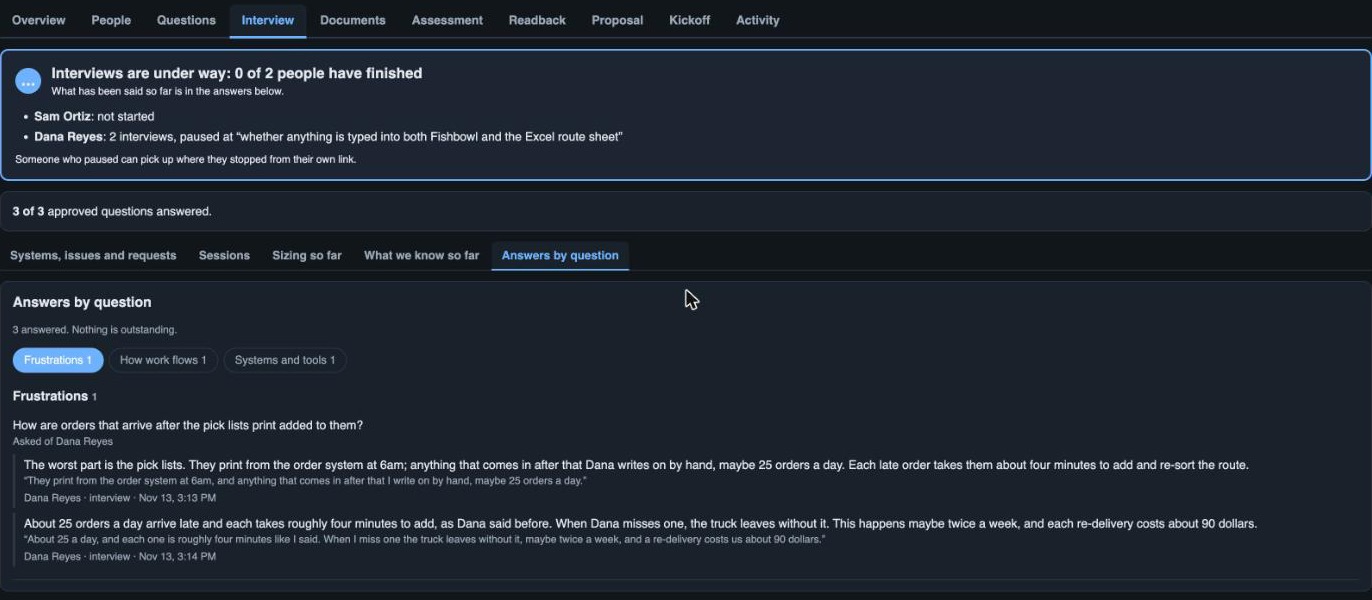
Answers, documents and screen recordings are written up. If someone shares a report or walks through the process on screen, that goes into the write-up next to what they said. A figure the client can look up carries more weight than one they estimate. Both are useful, and you can see which is which.
Each problem is sized in dollars from the client's own figures
Discover takes the figures from the interviews and works out what each problem costs in dollars. It uses the client's numbers, not industry benchmarks. A client can always say their business is different from a benchmark. They cannot easily argue with a number their own finance lead gave.
Here is an illustrative example for invoice rework at an imaginary client:
- Invoices corrected and reissued each month: about 30 (accounts receivable lead)
- Time to correct and reissue each one: about 30 minutes (accounts receivable lead)
- Hours spent each month: 30 × 0.5 = 15
- Cost of that time: $50 an hour, fully loaded (finance director)
- Monthly cost: 15 × $50 = $750
- Annual cost: $750 × 12 = $9,000
Three things make this work. Every line has a source the client recognises. Every step can be checked on a phone calculator in under a minute. And nothing is hidden inside a multiplier the client has to take on trust.
Your review decides which number goes forward
Nothing reaches the client until a person on your team approves it. This is where the number earns its trust, and it is quick work when the working is laid out line by line.
When you review each sizing, check a few things:
- Every input has a name next to it. If a line rests on a guess, decide whether it is good enough or worth confirming with the person who gave it.
- Ranges use the low end. If one person said twenty and another said thirty, the headline figure should use twenty.
- Softer effects stay separate. Late payments caused by wrong invoices, or time spent answering customer complaints, belong in a list marked as not counted. The client sees you thought about them and chose not to inflate the number.
Treat corrections as a gift. If the accounts receivable lead says it is closer to twenty invoices than thirty, the working becomes 20 × 0.5 = 10 hours, 10 × $50 = $500 a month, $6,000 a year. The total is smaller, but it is also harder to argue with. A smaller number the client believes is worth more than a larger one they doubt.
The client confirms the summary before anything is priced
Once you approve, the client sees a short summary. For each problem it shows what the problem is, the working, the total and the assumptions behind it. The client confirms it. Only then does Discover build what follows: the readback deck, a proposal priced from your firm's price list, a Statement of Work, your services agreement, online signing and a kickoff deck. You approve each one before the client sees it.
The order matters. A confirmed number changes the conversation. The question stops being whether the problem is worth solving and becomes how to solve it. Your price sits next to a cost the client has already agreed is real, so the comparison does the persuading for you.
The confirmation also helps later. When a new finance director joins the decision, or someone asks six months into the work where a figure came from, you can point to the confirmed summary and the names beside each input. That is far easier than reconstructing a conversation from memory.
Set it up once and use it on every engagement
The method builds trust because it runs the same way every time. Your setup is short. Keep your price list current so proposals price correctly. Load your services agreement. Then, for each engagement, choose who takes part and give the approvals the time they deserve.
Every discovery, large or small, ends with the same record: problem, inputs with sources, working, total, assumptions and the client's confirmation. Over time your team gets faster at reviewing it, and clients come to expect the working rather than just the answer. Clients rarely argue with arithmetic built from their own figures, and the proposal that follows is easier to write and easier to accept.
To see how the interviews feel from the client's side, try the two-minute interviewer or book a demo.