DiscoverPro / Blog / Discovery
What Discover does in a discovery week, and what stays with you
DiscoverPro · November 14, 2026 · 4 min read
When a senior consultant spends Tuesday afternoon formatting interview notes, the firm is paying judgment prices for record-keeping.
Ask a senior consultant about a discovery and they will tell you about the insight that changed the engagement. Look at their calendar and you see scheduling, typing up notes, chasing a spreadsheet and rebuilding last quarter's proposal. The insight usually happens in the gaps. Discover, the discovery side of DiscoverPro, takes on the capture, the arithmetic and the drafting, so your senior people spend their week on judgment: what to dig into, what to trust, what to recommend and what to approve.
Where the hours in a discovery week go
Every firm runs discovery a little differently, but the work breaks into the same pieces:
- Arranging interviews with the sponsor and the people who do the work.
- Running interviews with the coordinator, the analyst, the person who rekeys data from one system into another.
- Writing them up into notes a colleague can use.
- Chasing evidence: process documents, exports, the workaround everyone mentions.
- Sizing problems in terms the sponsor will accept.
- Getting agreement on a summary.
- Assembling outputs: readback deck, proposal, Statement of Work, contract and kickoff deck.
Only a few of these depend on years of experience. Discover is built to carry the rest.
Records go to Discover, decisions stay with you
A useful way to sort the work is to ask what each task produces. Some tasks produce a record: a transcript, a write-up, a filed document, a first draft of a deck. Others produce a decision: which problem matters most, which figure to trust, what to recommend and at what price.
Records need to be accurate and complete. They need a reliable process and someone to check them. Decisions are what clients pay senior rates for. When a senior consultant spends Tuesday afternoon formatting interview notes, the firm is paying judgment prices for record-keeping.
Problem sizing sits in between. The arithmetic is mechanical: time per task, times frequency, times people, times a loaded rate. The judgment is choosing which figures to believe. Discover does the first and shows its working, so your senior person spends their time on the second.
What Discover does, in order
Here is how a discovery runs once your firm is set up.
- You set the ground rules. Your price list and your services agreement go into DiscoverPro once. For each engagement you choose who to invite: the sponsor, and the people who do the work.
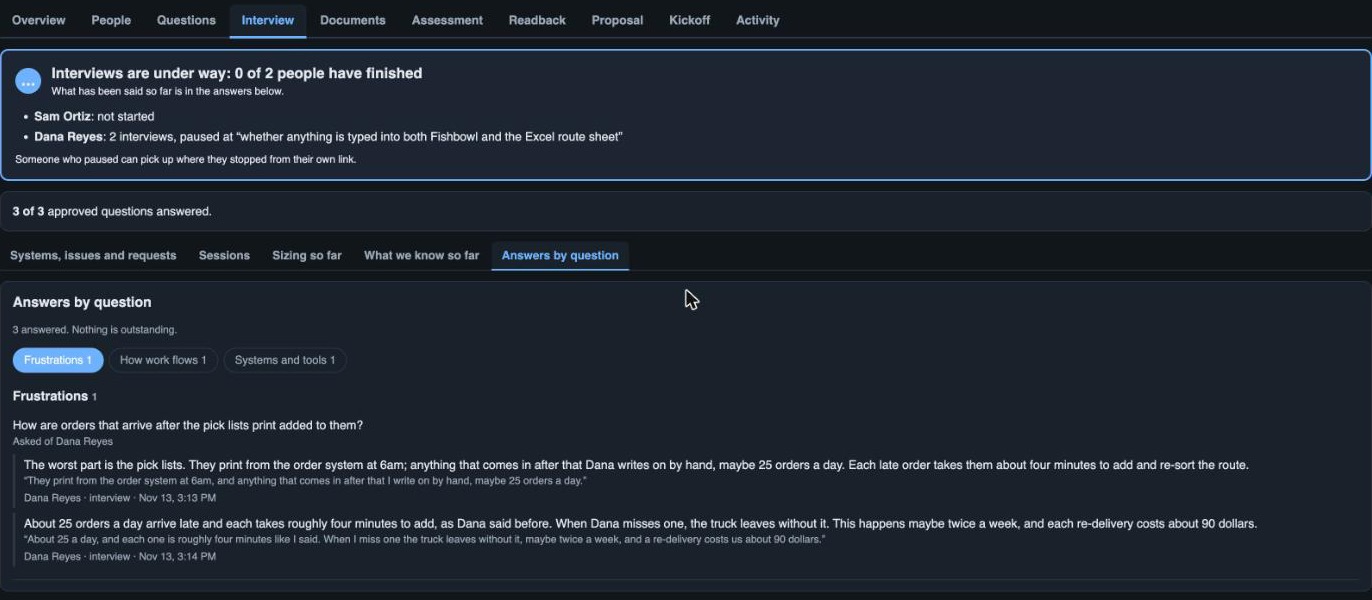
- The AI interviewer talks with each person. They answer by voice or by keyboard, at a time that suits them, and the interviewer asks follow-up questions as it goes. Frontline staff often say more this way, and nobody needs to juggle diaries.
- Evidence comes in with the answers. People can upload process documents and screen recordings of the awkward step, so you see the workaround instead of hearing it described.
- Everything is written up. Answers, documents and recordings become clean write-ups you can read side by side.
- Each problem is sized in dollars from the client's own figures. Take an example: rekeying an order takes, say, 20 minutes, happens 40 times a week, and three people do it, at a loaded rate of $60 an hour. That is 40 hours a week, or $2,400. Discover shows each figure and where it came from, so checking takes minutes.
- The client confirms a summary. The sponsor reviews the problems and their cost and corrects anything before a proposal is written.
- The documents are drafted. Discover produces a readback deck, a proposal priced from your price list, a Statement of Work, your services agreement ready for online signing, and a kickoff deck.
A person approves every one of these before the client sees it.
The judgment you keep, and where approval applies it
Handing off records only helps if the freed hours go somewhere better. These are the parts to protect:
- The sponsor conversation. Understanding what the sponsor needs to be true, politically as well as operationally, is senior work. Read the sponsor's interview closely and follow up in person where it matters.
- Reading across accounts. When finance and operations describe the same process differently, the gap is often the finding. Discover lays the accounts side by side. Deciding what the disagreement means is yours.
- Choosing which numbers to trust. A client's estimate of rework time may be generous or modest. Check the sizing, adjust a figure if you need to, and note why.
- Shaping the engagement. Which problems to tackle first, what to leave out, how to phase the work.
- Pricing departures. The price list covers the normal case. A pilot, a fixed fee or a discount is a commercial call you make in the proposal.
- The readback itself. Presenting findings and handling the room.
Approval is where your judgment is applied to everything Discover produced. It takes far less time than producing the work, and it is the step that makes the output yours.
Setting up your next discovery well
A few choices make the biggest difference to what Discover hands back:
- Keep your price list current. Proposals are priced from it, so a clean, up-to-date list means fewer edits at approval.
- Load your standard services agreement. The Statement of Work and contract follow your terms from the start.
- Invite the people who do the work. The coordinator and the analyst often hold the figures that make sizing credible. Include them, not just their managers.
- Ask for evidence in the invitation. Let people know a screen recording of the awkward step is welcome.
- Book judgment time. Put two protected sessions in the diary for reading the write-ups, checking the sizing and shaping the recommendation, and treat them like client meetings.
- Log the week. Note roughly where senior hours went, and compare with your last discovery.
Discovery will always need a senior mind. Discover handles the records, your people make the decisions, and nothing reaches the client until someone at your firm has approved it.
To see the interviewer for yourself, try the two-minute version at /try, or book a demo.