
DiscoverPro / Blog / AI in consulting
Can an AI run a discovery interview? Yes, if it is built for it.
DiscoverPro · November 14, 2026 · 3 min read
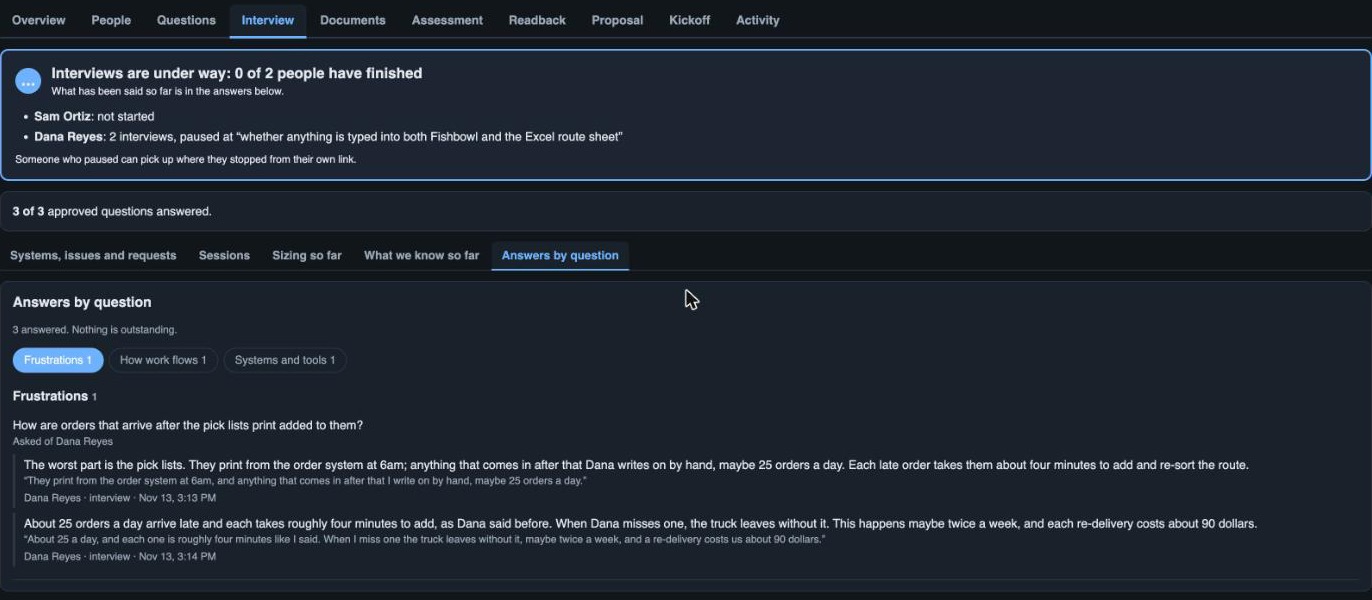
The interviewer does the first pass. Your consultants do what only they can.
Discovery is the hardest kind of interview to run. You are not ticking through a survey. You are finding out how work really gets done in someone else's business, and following the answer wherever it leads.
In January 2026 Nielsen Norman Group, the best-known usability research firm, tested two AI interview tools that worked from a fixed script, and concluded that tools like those were not ready for discovery. Their article is the clearest list we have seen of what a discovery interview demands. We treat it as a specification. DiscoverPro's interviewer was built to do each thing on it.
What a discovery interview needs, and how DiscoverPro does it
| What the interview needs | How DiscoverPro does it |
|---|---|
| Follow the insight, not a script | There is no script. The interviewer is given the ground to cover for that person's role and follows up on what they actually say: how often, how long, who, in what tool, what goes wrong. It already knows what the person told it last time, so it never asks twice. |
| Know when a topic is done, and keep to time | Every topic is tracked as covered, partly covered or open. Each sitting has a time limit. The interviewer wraps up on time, and the next sitting starts from the exact point the last one stopped. |
| Let people confirm what was heard | It plays back what it understood and asks what it got wrong. Afterwards the client receives a written summary to correct and confirm before anything is built on it. |
| Start properly, with consent | Your confidentiality agreement is signed before the first question. The interviewer says it is an AI and that the conversation is recorded, every time. |
| Respond without awkward pauses | Across 1,189 interviewer turns in our testing, it began to answer in a median of 1.6 seconds, and within 3.1 seconds nine times in ten. |
| See the work, not only hear about it | Mid-conversation, a person can record their screen doing the task or share the document they are describing. It is read and filed beside their answers. |
| Bring knowledge of the business | The interviewer works from your firm's playbook, your instructions for each area of a business, and the questions you want asked every time. Your experience shapes every interview. |
| Be consistent from one interview to the next | Every person gets the same thorough questioning, whoever they are and whenever they sit down. Every change to the interviewer is tested against eight simulated client characters and a checklist before it is used, and a gap check follows every interview. |
| Be comfortable to talk to | People answer by voice or by keyboard, on their own time, and can stop and come back. The interviewer is plain spoken and does not flatter. Anyone can ask for a person at any point. |
What you get that a meeting does not give you
- The same depth from everyone. The dock clerk and the owner are both asked how often, how long and what it costs. Nobody forgets to ask.
- Every answer in their own words. Each finding is written up plainly, with the client's own words quoted beneath it, so you can show where a number came from.
- No calendars. Four people can be interviewed in the same afternoon, each when it suits them, without two of your consultants in every room.
- Numbers, not impressions. What people say about volume, time and cost is turned into what each problem costs today and what fixing it would save.
The numbers we measured
- 1,189 interviewer turns recorded by the voice service across our testing.
- 1.6 seconds median from the person finishing to the interviewer starting to speak.
- 3.1 seconds or less, nine times in ten.
These are our own measurements, from our own testing.
Where your consultants come in
The study's advice is to use AI alongside people, and DiscoverPro is built that way. The interviewer does the first pass. Your consultants do what only they can.
- They see what is thin. After every interview a gap check shows what is still missing to size each problem, with follow-up questions drafted and ready to send.
- They follow up. A short second interview, an invitation to someone who was mentioned, or a phone call. Their choice.
- They hold the conversations that are the relationship. The first meeting with a chief executive, the readback, the proposal.
- They sign off. Nothing reaches the client until one of your people has read and approved it.
The result is a discovery that is more thorough than most firms have time to run by hand, with your senior people spending their hours on judgment instead of note-taking.