DiscoverPro / Blog / Discovery
How DiscoverPro turns discovery into a signed SOW in a week
DiscoverPro · November 14, 2026 · 5 min read
The sponsor can check every input, so any debate is about the inputs, not your credibility.
A signed Statement of Work a week after the first call is realistic once the slow work is no longer done by hand. Most delays in a sale come from the firm's side, not the client's. A price gets built from scratch. Nobody can find the contract template. Interviews were never booked, and the write-up waits for a free evening. In DiscoverPro, Discover does the interviewing, writing up, sizing and drafting. Your part is to set up the firm once, then review and approve what Discover produces. Here is how that week runs, in order.
You set up prices and paperwork once, before the first deal
Discover drafts proposals and contracts from what you give it, so the setup is where your judgment matters most. You do it once, and every discovery after that starts from the same place.
- Your price list. List the services you sell, the unit each is priced in (a day, a workshop, a fixed-scope deliverable, a monthly retainer) and the standard rate. Include fixed packages for work you do often, such as a process review or a reporting rebuild, and day rates by role for the rest. Discover prices every proposal from this list, so agree it with whoever signs off on pricing.
- Your services agreement. These are your standing terms: payment, confidentiality, ownership of work, liability. Have your lawyer review it once, before you need it, so it never goes out for review in the middle of a deal.
- The rules you apply when you approve. Decide your discount, rush and travel conditions now, along with a minimum engagement size. Then nobody negotiates against themselves on a call.
With that in place, a proposal no longer waits on a partner's free afternoon. It arrives as a draft built from your own prices and terms, ready for you to check.
Discover interviews the sponsor and the people who do the work
A week leaves no room for a second round of interviews, so the first round has to reach the right people quickly. On the first call, ask the sponsor for three things:
- the names of the people who do the work;
- permission to talk to them this week;
- any documents that show how things run today.
Process maps, reports, spreadsheets and short screen recordings of the task all help.
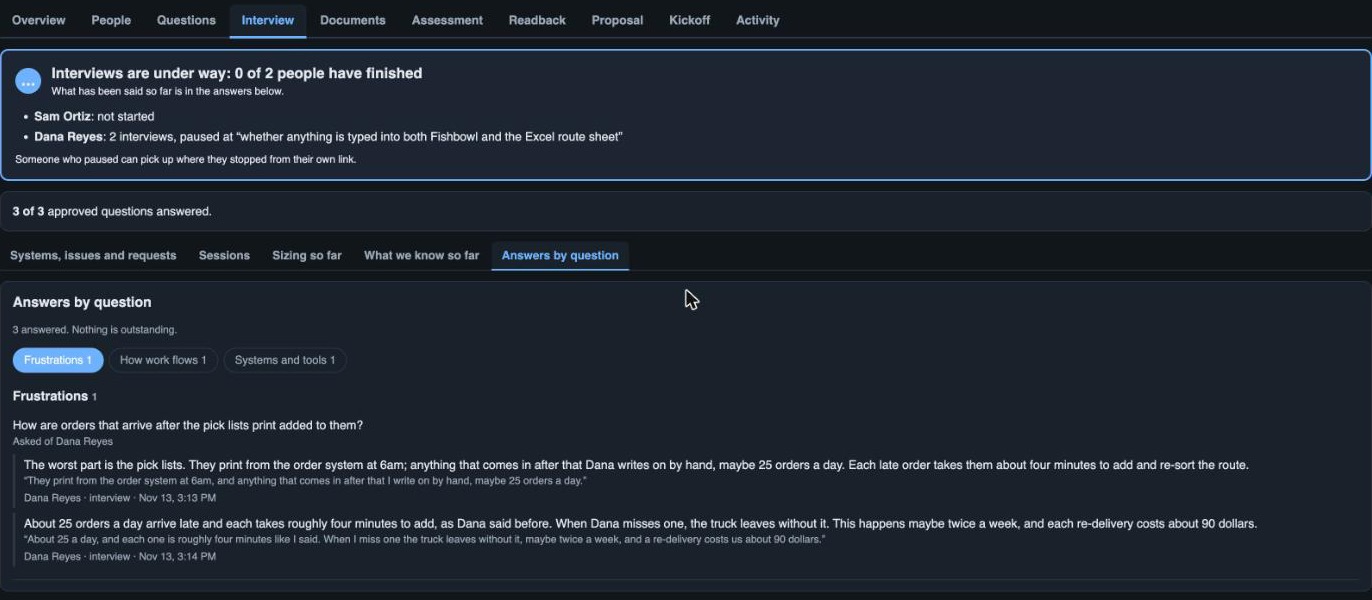
Discover's AI interviewer then talks with the sponsor and with each of those people. The conversations draw out goals, how success will be judged and what has been tried. They also get the detail of the work: the steps, the time each takes, how often it happens and where it goes wrong. Each person chooses voice or keyboard. Some prefer to talk. Others give better detail typing at their desk between tasks. Several interviews can run on the same day without anyone on your team booking them back to back.
Discover writes up the answers, documents and screen recordings. You read clear write-ups rather than a pile of notes. Your job here is to check that the right people took part and that the picture holds together. If a team is missing, ask the sponsor for a name.
Each problem is sized in dollars and confirmed by the client
Proposals stall when the client is not sure the problem is worth the fee. Discover sizes each problem in dollars from the client's own figures and keeps the arithmetic visible. Take an example: say, thirty estimates a month, each needing four hours of rework, multiplied by the estimator's hourly cost. The sponsor can check every input, so any debate is about the inputs, not your credibility.
Discover then puts together a summary of what it heard: the problems, their size and what is out of scope. You review and approve it, and the client confirms it before any proposal is written. That step costs a day and saves more than a day. A confirmed summary means the readback holds no surprises. It also means the SOW describes something the client has already agreed is real.
From a confirmed summary to a signed SOW
Once the client confirms, Discover produces the rest of the sale from the same material:
- A readback deck that walks the sponsor through what was heard, what it costs them today and what you recommend.
- A proposal priced from your price list.
- A Statement of Work covering scope, deliverables, timeline and fees.
- Your services agreement, ready to go with it.
- Online signing, so a sponsor can sign the afternoon they read it, without printing or scanning.
- A kickoff deck for the first meeting once the work is signed.
A person approves everything before the client sees it, and this is where your judgment earns the fee. Check four things:
- Does the recommendation fit the problems?
- Does the total make sense against the value of fixing them?
- Do any of your discount or rush rules apply?
- Is anything promised that you would not want to deliver?
Edit what needs editing, then approve.
Book the week and the approvals on day one
Discover moves the work along quickly, so people's calendars set the pace of the week. Put the whole week in the diary during the first call, including the readback meeting and your own review points. A plan might look like this:
- Day 1: first call with the sponsor. Interviewees named, documents requested, readback booked.
- Days 2 and 3: Discover runs the interviews and writes up answers, documents and recordings. You read the write-ups.
- Day 4: problems sized. You approve the summary and the sponsor confirms it.
- Day 5: readback meeting. You review and approve the proposal and SOW, and they are sent.
- Days 6 and 7: questions answered and the agreement and SOW signed online. You approve the kickoff deck and book the kickoff.
Name the person on your side who approves each document, and block their time now. A reviewer who first sees the proposal late on Friday is an easy way for one week to become three.
So the setup is small: a price list, a services agreement and an approver with time in the diary. Discover handles the interviews, the sizing and the drafting. That leaves your week for the judgment calls that win the work.
Try the two-minute interviewer at /try, or book a demo to see the week end to end.